From Roll Calls to Real-Time Data: Why Every College Needs a Student Attendance Management System in 2025

Audio Summary
Picture this: a professor walks into a lecture hall of 120 students, calls out names one by one, marks a register, and by the time attendance is done — 15 minutes of teaching time are already gone. Multiply that across six sessions a day, five days a week, and you're looking at hundreds of hours lost annually to a task that technology solved years ago.
In 2025, educational institutions can no longer afford to run 21st-century classrooms on 20th-century processes. The Student Attendance Management System (SAMS) has emerged as one of the most impactful EdTech tools colleges can adopt — not just for saving time, but for improving student outcomes, ensuring compliance, and enabling data-driven academic decisions.
What Is a Student Attendance Management System?
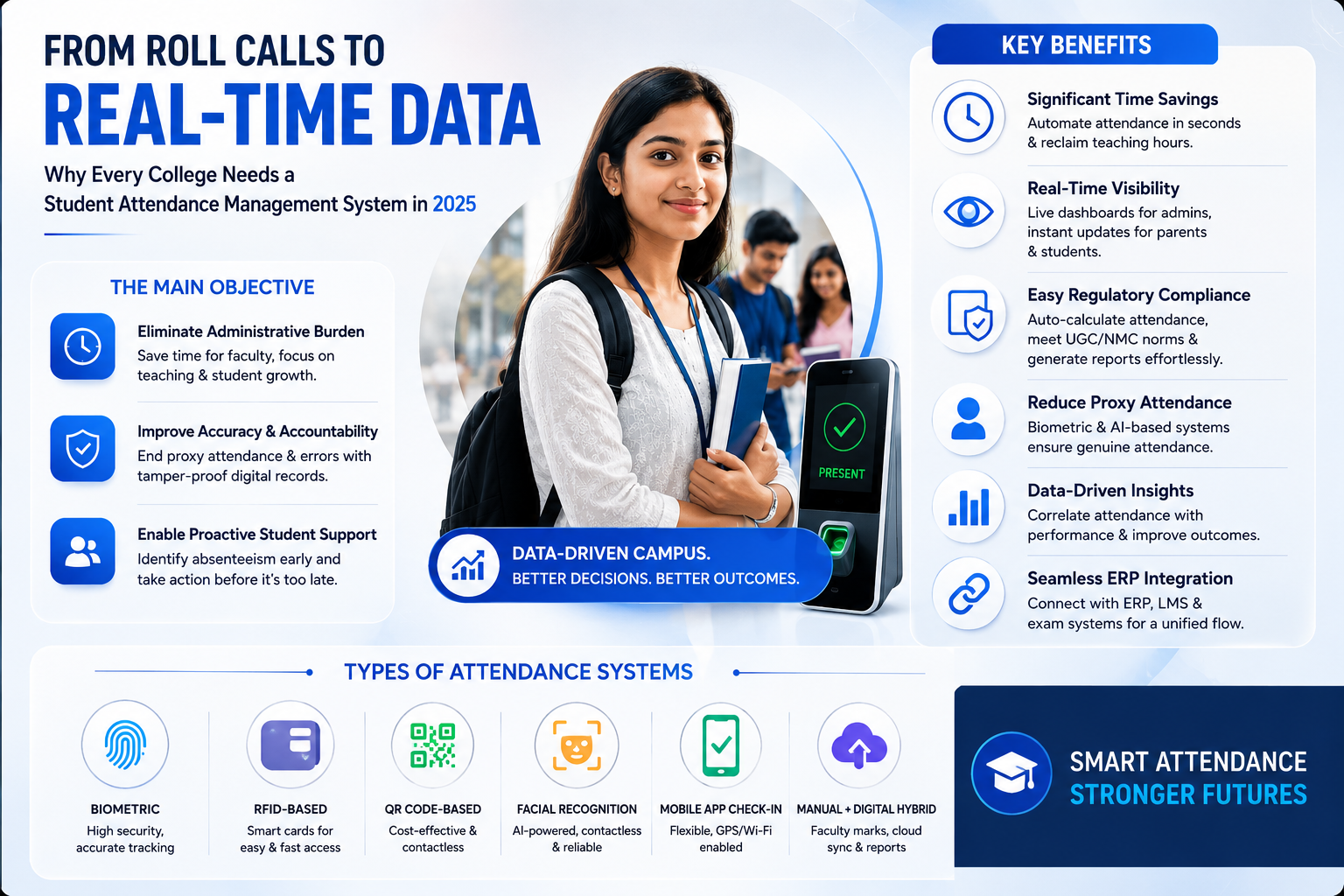
A Student Attendance Management System is a digital platform — or a combination of hardware and software — that automates the process of recording, tracking, and reporting student attendance in educational institutions.
Unlike traditional paper registers or manual spreadsheets, a modern SAMS integrates with college ERP systems, student portals, and communication tools to provide real-time attendance data accessible to teachers, administrators, students, and parents.
- Automated attendance marking via biometrics, RFID, QR codes, or facial recognition
- Real-time dashboards for faculty and admin
- Automated alerts to students and parents for low attendance
- Attendance reports linked to academic performance
- Compliance tracking for regulatory bodies (UGC, MCI, university affiliates)
What Is the Main Objective of an Online Attendance Management System?
1. Eliminating Administrative Burden: Manual attendance is one of the most time-consuming non-teaching tasks faculty face. A SAMS removes this entirely, freeing teachers to focus on pedagogy, student engagement, and curriculum development.
2. Improving Accuracy and Accountability: Human error, proxy attendance, and lost registers are perennial problems. Digital systems create tamper-proof, timestamped records that ensure accuracy and discourage malpractice.
3. Enabling Proactive Student Support: Early identification of attendance drops allows faculty and counsellors to intervene before a student falls behind — converting a reactive process into a proactive one.
Key Benefits of a Student Attendance Management System
Significant Time Savings for Faculty: Automated attendance completes in seconds what used to take 10–20 minutes per session. For a department with 10 faculty members taking 4 classes daily, this recovers hundreds of productive hours per semester.
Real-Time Visibility for All Stakeholders: Administrators get a live attendance dashboard. Parents receive instant notifications when their child is absent. Students can check their own attendance percentages through self-service portals.
Regulatory Compliance Made Simple: A SAMS auto-calculates attendance percentages, flags students at risk of debarment, and generates compliance reports for audits — eliminating last-minute panic.
Reduction in Proxy Attendance: Biometric and facial recognition-based systems make proxy attendance virtually impossible.
Data-Driven Academic Decisions: When attendance data is correlated with academic performance, colleges can identify which subjects see the highest absenteeism, which student cohorts are at risk, and where scheduling adjustments are needed.
Seamless Integration with College ERP: Modern SAMS platforms integrate with existing ERP systems, exam portals, and LMS tools — creating a unified academic management ecosystem.
Improved Student Engagement and Accountability: When students know their attendance is tracked in real time and their parents are notified instantly, behavioural outcomes shift significantly.
Types of Attendance Systems Available
- Biometric (Fingerprint): Students scan fingerprints at entry points. Best for high-security campuses and large institutions.
- RFID-Based: Smart ID cards interact with readers at entry. Best for campuses with existing smart card infrastructure.
- QR Code-Based: Time-bound QR codes generated per session. Cost-effective and BYOD-friendly.
- Facial Recognition: AI cameras match students automatically. Contactless and post-COVID preferred.
- Mobile App Check-In: GPS/Wi-Fi-based attendance via student app. Ideal for flexible scheduling and blended learning.
- Manual + Digital Hybrid: Faculty marks on app, data syncs to cloud. Best for transitioning institutions.
What Is the Attendance Rule in Medical Colleges?
Medical colleges operate under stricter attendance mandates governed by the National Medical Commission (NMC) in India. MBBS students must maintain a minimum of 75% attendance in theory and practical/clinical sessions separately to be eligible for university examinations. Attendance is tracked module-wise and subject-wise — not just overall. For medical colleges, an automated SAMS isn't a convenience — it's a compliance necessity.
What Does an Ideal Attendance Management System Look Like?
- Multi-modal — Supporting biometric, QR, and app-based marking
- Real-time — Attendance data live, not batch-updated at end of day
- Integrated — Seamlessly connected to college ERP, LMS, and exam management
- Automated in alerts — Proactive notifications when attendance drops below threshold
- Analytics-ready — Dashboards surfacing subject-wise absenteeism and cohort risk levels
- Compliance-configured — Pre-built rules for UGC, NMC, or university-specific mandates
- Scalable — Capable of handling institutions from 500 to 50,000 students
- Mobile-first — Faculty can mark and review attendance from their phones
Conclusion
The Student Attendance Management System is no longer an optional upgrade — it is foundational infrastructure for any college serious about academic excellence, operational efficiency, and student success.
Faculty time is reclaimed for teaching, students are held accountable through transparency, administrators are armed with data, and institutions are audit-ready at any moment. As EdTech continues to mature in 2025 and beyond, colleges that invest in intelligent attendance systems aren't just streamlining a process — they're building the data backbone for smarter, more responsive academic institutions.
The register is closed. The future is automated.
Related Articles
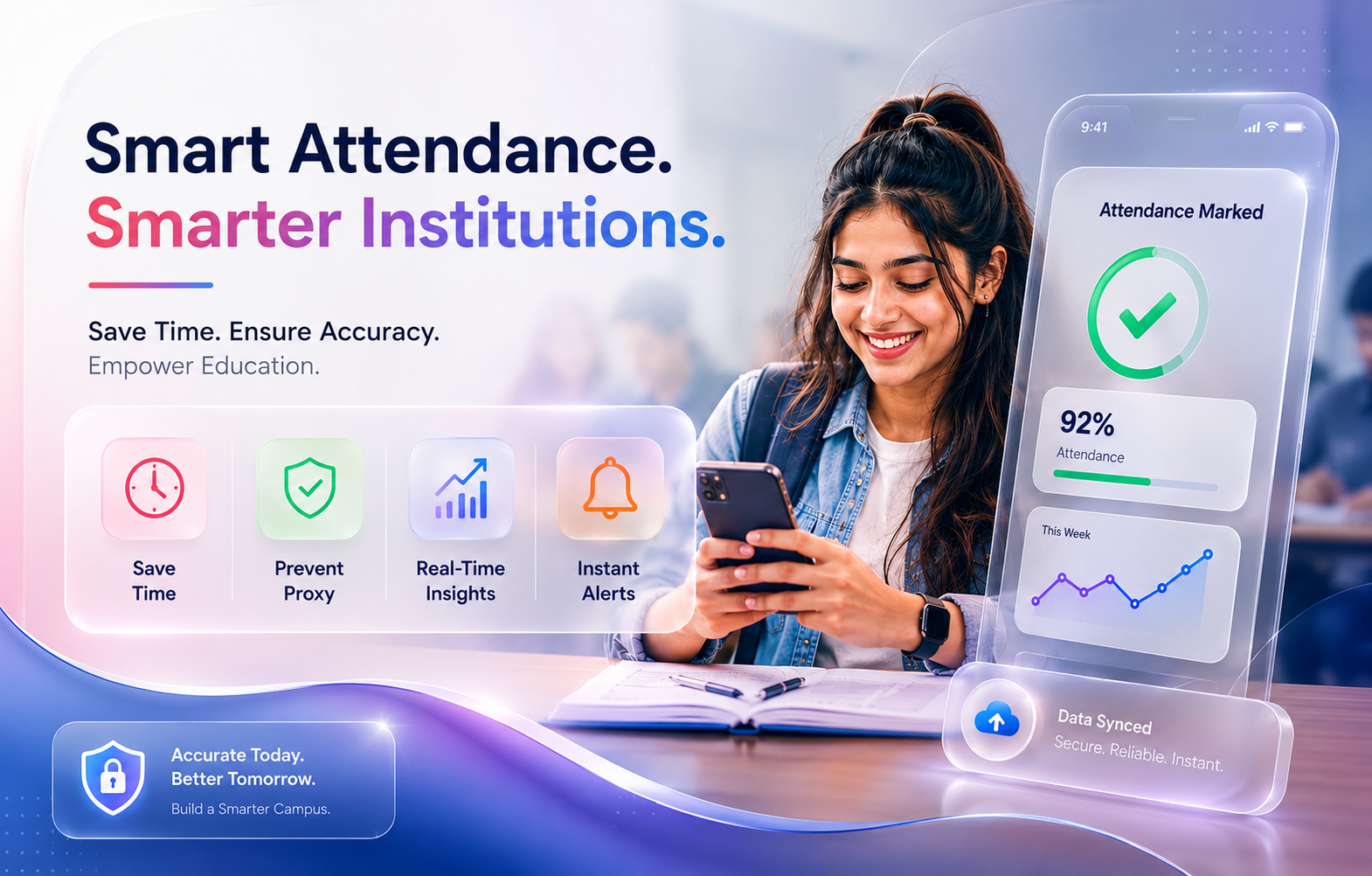
Why Your Institution Is Losing Valuable Time Without an Online Student Attendance Management System
21 Feb 2026 • 6 min read
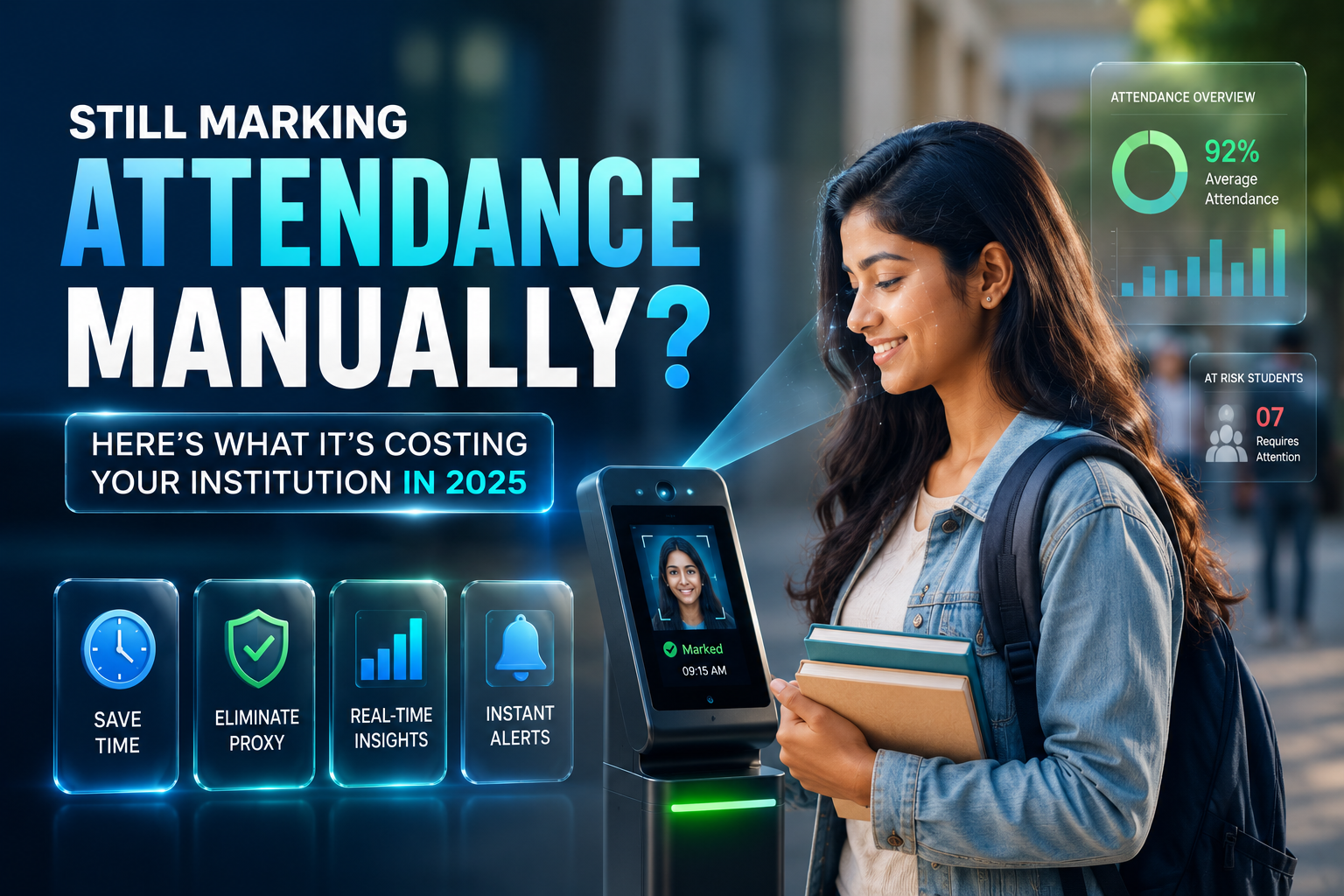
Still Marking Attendance Manually? Here's What It's Costing Your Institution in 2026
01 Jun 2026 • 6 min read

From Clipboards to Cloud: How to Build an Effective Visitor Management System in 2026
15 May 2026 • 7 min read