Is Your Attendance System Silently Draining Your Budget? Here's How Face Recognition Fixes That

Audio Summary
Picture this, 200 employees. Each spends 3 minutes on manual attendance daily. That's 600 minutes — 10 hours — gone every single day, before the workday even begins.
Multiply that across a year, and you're looking at thousands of hours of lost productivity. And that's before accounting for proxy attendance, human errors in payroll, and the HR bandwidth consumed by reconciling mismatched records.
Manual attendance isn't just an inconvenience — it's a hidden operational liability. A face recognition attendance system eliminates this liability entirely.
What Is a Face Recognition Attendance System?
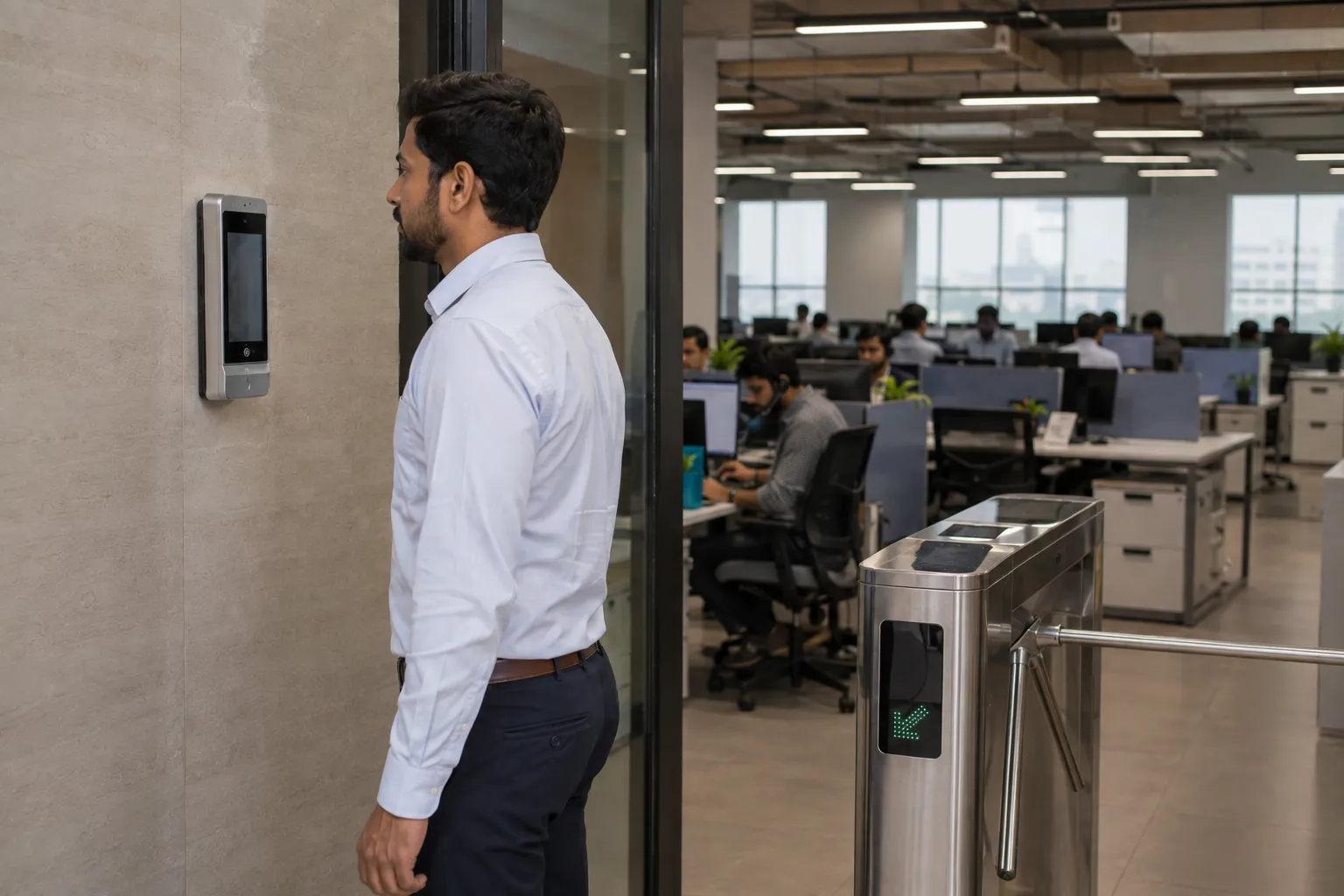
A face recognition attendance system is an AI-powered biometric solution that automatically identifies employees using unique facial features — the geometry of their eyes, nose, jawline, and facial structure — and logs their attendance the moment they appear in front of a camera-enabled device.
Unlike traditional systems that rely on cards, PINs, or manual registers, this system requires nothing from the employee except their presence.
How Does It Work?
1. Data Capture: High-definition cameras capture facial images of each individual under varying lighting conditions and angles, ensuring accuracy regardless of environmental changes.
2. AI-Powered Analysis: The system's algorithms extract unique facial landmarks — the distance between eyes, the contour of the nose, the shape of the jawline — creating a digital faceprint as unique as a fingerprint.
3. Real-Time Comparison: This faceprint is instantly cross-referenced against the organisation's enrolled database. The entire process takes a fraction of a second.
4. Verification & Logging: A match triggers automatic attendance logging. A failed match triggers an alert — preventing impersonation or proxy attendance before it becomes a payroll problem.
The Real Cost Savings: What Changes When You Switch
- Elimination of Buddy Punching & Proxy Attendance: Facial recognition makes proxy attendance structurally impossible — you cannot send someone else's face.
- Payroll Accuracy, Every Time: Face recognition systems integrate directly with payroll platforms, feeding accurate real-time data and eliminating costly corrections.
- Reduced Administrative Overhead: HR teams no longer spend hours resolving attendance disputes or correcting muster rolls.
- Zero Infrastructure for Identity Management: No ID cards to print, replace, or manage. No PINs to reset. The employee's face is the credential.
- Real-Time Visibility for Decision Makers: Live dashboards, late-arrival alerts, and workforce analytics allow managers to act on attendance data the moment it's generated.

Key Components of a Modern System
- Hardware: High-resolution cameras with IR capability, edge-computing devices, and a reliable server or cloud backend.
- Software: AI engine handling face detection, feature extraction, liveness detection, and matching — integrated with HRMS, ERP, and access control platforms.
- Data Infrastructure: A well-maintained database of enrolled faces covering multiple angles and lighting conditions for ongoing accuracy.
Face Recognition Attendance in 2025: What's New
- Liveness Detection prevents spoofing via printed photos or screen replays.
- Edge AI Processing allows attendance logging even without internet, syncing when connectivity is restored.
- Multi-modal Biometrics combine face recognition with other identifiers for high-security environments.
- Cloud-based Platforms allow multi-location businesses to manage attendance from a single dashboard in real time.
Who Benefits Most?
- Manufacturing & Logistics: Large shift-based workforces where proxy attendance is common and costly.
- IT & Corporate Offices: Where accurate payroll and flexible work-hour policies need seamless tracking.
- Educational Institutions: For student and staff attendance with zero administrative burden.
- Healthcare: Where precise attendance records have compliance and regulatory implications.
- Retail Chains: Multi-location businesses needing centralised real-time workforce visibility.
Bottom Line
Every day you rely on manual attendance, you're paying for inefficiency you don't see — in lost time, payroll errors, proxy abuse, and HR overhead.
A face recognition attendance system doesn't just modernise your process. It closes the financial leaks that manual systems make invisible.
The question isn't whether you can afford to invest in one. It's whether you can afford not to.
Related Articles

Why Your Institution Is Losing Valuable Time Without an Online Student Attendance Management System
21 Feb 2026 • 6 min read

From Clipboards to Cloud: How to Build an Effective Visitor Management System in 2026
15 May 2026 • 7 min read

Smart Attendance, Zero Proxies: How AI-Powered College Attendance Systems Are Solving a Decades-Old Problem
20 Apr 2026 • 5 min read