Why Every Organisation Needs a Centralised Attendance Management System in 2025

Audio Summary
Manual registers. Disconnected spreadsheets. Hours lost to reconciling data across departments. If this sounds familiar, your organisation is haemorrhaging time and money on a problem that modern technology solved years ago.
A Centralised Attendance Management System (CAMS) isn't just a digital upgrade — it's a strategic shift in how businesses and educational institutions track time, manage compliance, and empower their people.
What Is a Centralised Attendance Management System?
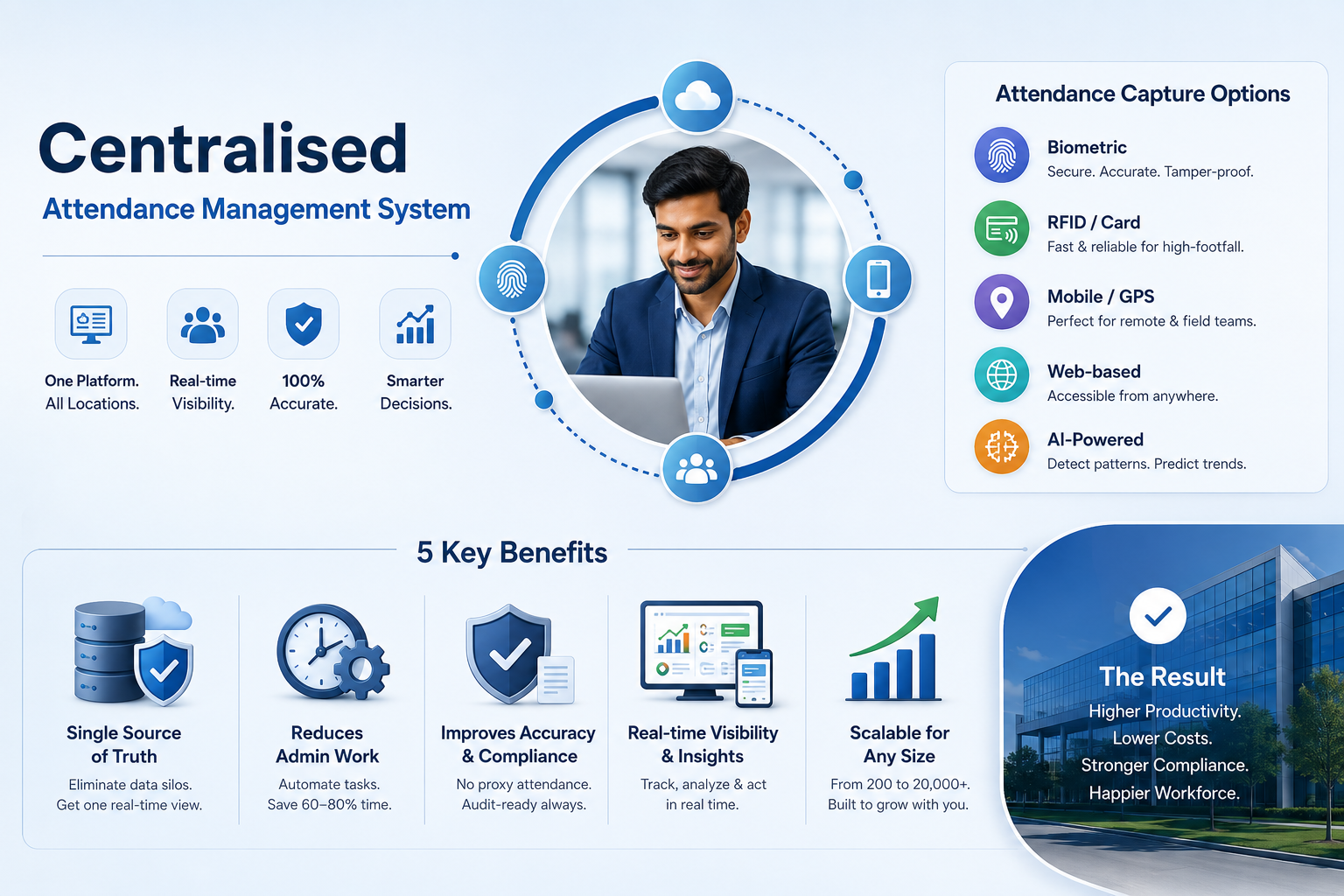
A Centralised Attendance Management System is a unified platform that tracks, records, and manages attendance data across all departments, branches, or campuses of an organisation — from a single interface.
Instead of each department running its own system and generating its own data silos, a CAMS consolidates everything into one source of truth. Whether you're managing 200 employees across three offices or 5,000 students across multiple campuses, the same platform gives administrators, HR teams, and leadership real-time visibility — without the back-and-forth.
What Makes an Attendance Management System Truly Effective?
- Real-time attendance tracking — Know who's present, absent, or late the moment it happens
- Automation — Eliminate manual data entry and the human error that comes with it
- System integration — Seamless connectivity with your HRMS, payroll, ERP, or LMS
- Comprehensive reporting and analytics — Actionable insights, not just raw data
- Scalability — A system that grows with your organisation
- Compliance support — Built-in audit trails and policy enforcement to meet regulatory requirements
Types of Attendance Systems: Which One Fits Your Needs?
- Manual/Paper-based Systems: The legacy approach. Simple but error-prone, slow to process, and impossible to scale.
- Barcode and RFID-based Systems: Employees or students scan ID cards to mark attendance. Fast, reliable, and ideal for high-footfall environments like warehouses, factories, and large campuses.
- Biometric Systems: Fingerprint scanners, facial recognition, or iris detection ensure attendance cannot be proxied or faked. Highly accurate and tamper-resistant.
- Mobile and Web-based Systems: Attendance marked via smartphones or web portals, often using GPS geo-fencing to verify location. Ideal for remote or hybrid workforces.
- AI-powered Smart Attendance Systems: These systems detect patterns, flag anomalies, predict absenteeism trends, and integrate with workforce planning tools.
5 Key Benefits of a Centralised Attendance Management System
1. Eliminates Data Silos and Delivers a Single Source of Truth: When every department manages its own attendance records, you end up with inconsistent data and no reliable organisation-wide view. A centralised system ensures HR, operations, finance, and leadership all work from the same real-time data — payroll calculations, compliance reports, and workforce analytics all aligned.
2. Dramatically Reduces Administrative Burden: A centralised system automates the repetitive work — leave balance calculations, overtime tracking, exception alerts, and report generation. Organisations that switch from manual to automated systems typically report a 60–80% reduction in time spent on attendance administration.
3. Improves Data Accuracy and Compliance Readiness: Centralised systems with biometric or RFID inputs eliminate proxy attendance entirely. Automated audit trails ensure every record is timestamped, traceable, and tamper-evident. When a compliance review comes around, your data is ready — not scrambled together at the last minute.
4. Provides Real-Time Visibility and Actionable Insights: Real-time dashboards let managers see at a glance who's in, who's out, and where attendance is trending. Analytics can surface patterns like chronic late arrivals, department-level absenteeism spikes, or leave abuse before they become operational problems.
5. Scales Seamlessly Across Locations, Teams, and Growth: Whether you're expanding from one office to five or integrating a newly acquired entity, a centralised attendance system adapts without rebuilding from scratch. Role-based access controls mean each department head sees what they need, while leadership has the full picture.
What Is a Smart Attendance Management System?
A smart attendance management system layers AI and machine learning on top of core tracking functionality. Smart systems can predict absenteeism trends, automatically flag policy violations, integrate with productivity platforms, use facial recognition for touchless check-in, and generate automated alerts for compliance thresholds.
Who Benefits Most?
- Enterprises and large corporates with multi-location footprints and complex workforce structures
- Educational institutions — schools, colleges, and universities — for unified student and staff tracking and automated parent notifications
- Healthcare organisations for accurate shift tracking, compliance-ready audit trails, and biometric verification
- Manufacturing and logistics operations for real-time visibility into shift attendance, overtime management, and contractor tracking
The Bottom Line
Attendance management isn't a back-office function anymore — it's a strategic capability. The organisations that treat it that way are gaining real advantages: lower administrative costs, cleaner compliance records, sharper workforce intelligence, and more time for their people teams to do meaningful work.
A centralised attendance management system is the foundation. A smart one is the competitive edge. The question isn't whether your organisation needs one — it's how much longer you can afford to operate without it.
Related Articles
Why Your Institution Is Losing Valuable Time Without an Online Student Attendance Management System
21 Feb 2026 • 6 min read
Still Marking Attendance Manually? Here's What It's Costing Your Institution in 2026
01 Jun 2026 • 6 min read
From Clipboards to Cloud: How to Build an Effective Visitor Management System in 2026
15 May 2026 • 7 min read