Still Calling Names Aloud? It's Time to Let AI Handle Attendance

Audio Summary
What Is a Student Attendance Management System?
A Student Attendance Management System (SAMS) is an integrated digital ecosystem designed to replace error-prone, time-consuming manual roll calls with a seamless, automated process. At its core, it combines smart attendance hardware, cloud-based software, and a centralised data layer — all working in sync.
A modern SAMS eliminates the three most persistent pain points for educational institutions: proxy attendance, delayed absence alerts, and administrative overload. Whether you're managing a single school or a multi-campus university, the system scales to meet your needs without adding complexity.
How Does a Smart Attendance System Work?
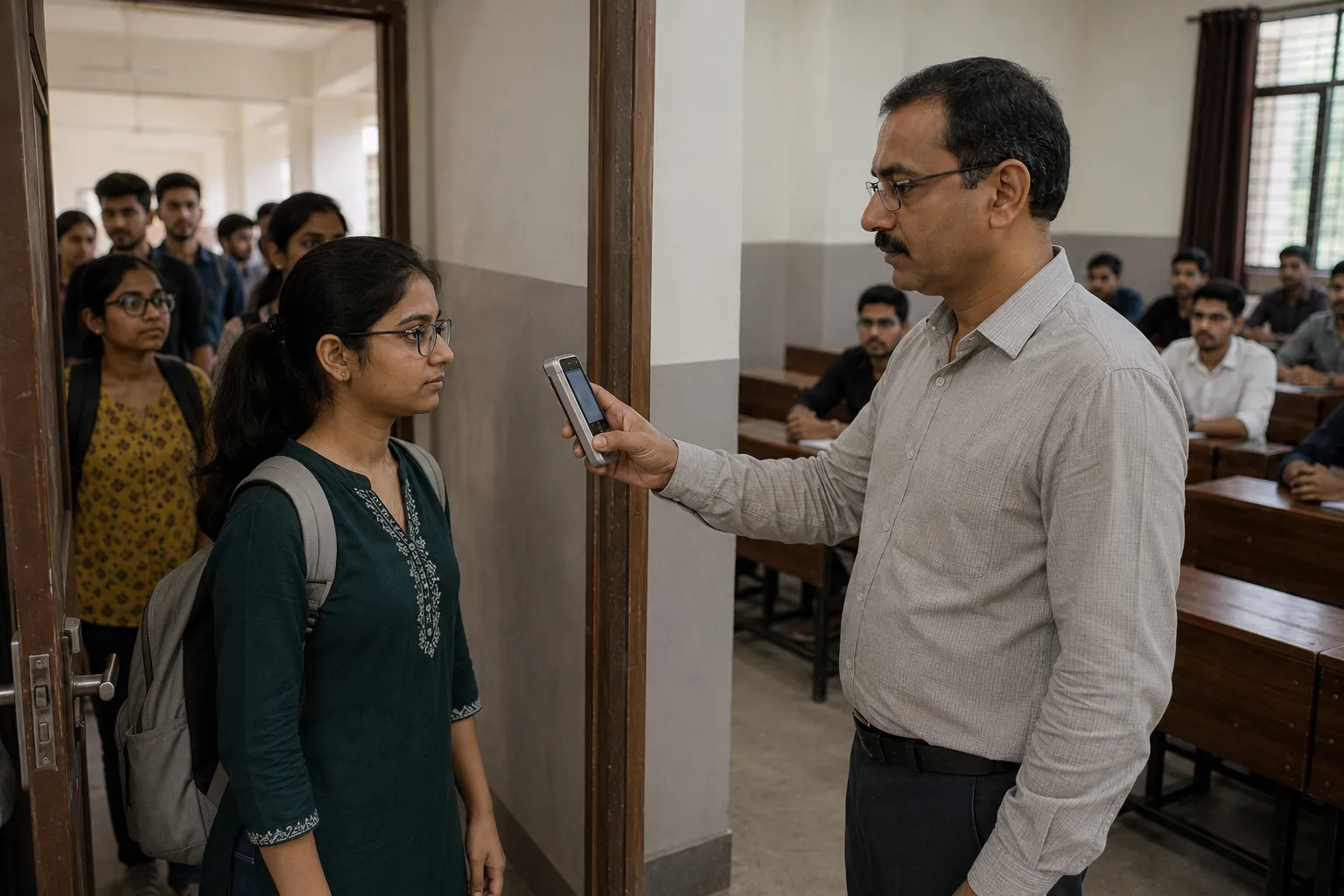
1. Instant Biometric Capture: A student looks at the device for less than 0.1 second. Live face detection confirms presence in real time — no cards, no PINs, no proxies.
2. Automatic Cloud Synchronisation: The moment attendance is recorded, data is pushed to a central server. No manual data entry, no end-of-day uploads, no risk of records being lost.
3. Intelligent Alerts and Escalation: When a student's attendance drops below a defined threshold, the system immediately notifies parents and faculty — before the issue compounds.
4. On-Demand Reporting for All Stakeholders: Teachers, administrators, and compliance teams can generate granular attendance reports anytime, from any device — filtered by date, class, student, or department.
The Real Cost of Manual Attendance
In a class of 60 students, calling names takes 5–10 minutes per session. Multiply that across hundreds of classes per week, and institutions are losing thousands of hours annually to a process that can be fully automated.
Beyond time, the integrity of manually collected attendance data is fragile. Students answer for absent classmates. Registers get misplaced. Handwritten records are transcribed with errors. Parents receive no real-time visibility. And compliance reporting becomes a reactive, labour-intensive exercise rather than a proactive one.

Key Benefits of an Automated Attendance System
- Reclaimed Faculty Time: Teachers spend zero time on roll calls — that attention goes back to instruction where it belongs.
- Zero-Proxy Accuracy: Live face recognition cannot be fooled by a classmate answering on someone else's behalf.
- Proactive Shortage Alerts: Parents and counsellors are notified automatically when attendance falls below the defined threshold.
- Instant Compliance Reporting: Generate audit-ready reports in seconds — no manual compilation, no data reconciliation.
- Tamper-Proof Data Integrity: All records are stored securely on a central server with a full audit trail.
- Parent Transparency: Families get real-time visibility into their child's attendance, building trust between school and home.
Is This the Right Time to Switch?
Face recognition attendance technology has matured significantly. Today's systems are faster, more accurate, and more cost-effective than ever — and they integrate directly with existing school management software, making adoption smoother than most institutions expect.
Every year spent on manual attendance is a year of inaccurate records, wasted faculty hours, and missed early-intervention opportunities for at-risk students.
Frequently Asked Questions
Does face recognition work with masks or glasses? Modern systems handle partial occlusions well. Most enterprise-grade solutions maintain high accuracy even with glasses; mask compatibility varies by vendor.
Is student biometric data stored securely? Reputable systems store encrypted facial templates — not raw images — on secure servers, with access controls aligned to data protection regulations like India's DPDP Act or GDPR.
How long does implementation take? Most deployments are completed within two to four weeks for a single campus, including hardware installation, software configuration, and staff training.
Can the system integrate with our existing student information system? Yes — leading SAMS platforms offer API-based integrations with popular SIS and ERP platforms.
Conclusion
The shift from manual roll calls to AI-powered face recognition isn't a distant possibility — it's happening in institutions across India and the world right now. The technology is proven, the implementation is straightforward, and the returns are measurable: more teaching time, better data, happier parents, and students who can no longer game the system.
Don't let an outdated process hold your institution back. The upgrade is simpler than you think — and the cost of waiting is higher than it looks.
Related Articles

Why Your Institution Is Losing Valuable Time Without an Online Student Attendance Management System
21 Feb 2026 • 6 min read

Is Your Attendance System Silently Draining Your Budget? Here's How Face Recognition Fixes That
10 Apr 2026 • 5 min read

From Clipboards to Cloud: How to Build an Effective Visitor Management System in 2026
15 May 2026 • 7 min read